Posts

Showing posts with the label Power Plant

Keep in Touch with Biomass Power Plant

Image
PNG Biomass grows up to 10 million seedlings a year in nurseries in the Markham Valley in Papua New Guinea. They will generate 30 MW of electrical power by growing the seedlings into trees, processing the timber logs into woodchips, and burning them in a biomass power plant. Process The seedlings are planted over 16,000 hectares of plantations to grow for 5 to 8 years to mature into trees. While the trees grow they absorb from the atmosphere Carbon Dioxide through the process of photosynthesis. Mature trees are harvested, debarked, and loaded as tree logs onto trucks. Tree logs are then transported to a centrally located power plant site. Tree logs are processed on site into wood chips to fuel our biomass power plant. Wood chips are channelled into the combustion chamber through a conveyor system and burned to heat water in the boiler. The burning wood chips release stored carbon dioxide back into the atmosphere, remaining ash is used as plantation fertiliser an...
Ocean Thermal Energy Conversion

Image
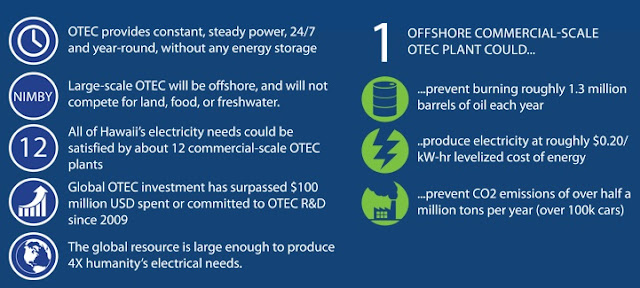
Ocean Thermal Energy Conversion (OTEC) is a process that can produce electricity by using the temperature difference between deep cold ocean water and warm tropical surface waters. OTEC plants pump large quantities of deep cold seawater and surface seawater to run a power cycle and produce electricity. OTEC is firm power (24/7), a clean energy source, environmentally sustainable and capable of providing massive levels of energy. Recently, higher electricity costs, increased concerns for global warming, and a political commitment to energy security have made initial OTEC commercialization economically attractive in tropical island communities where a high percentage of electricity production is oil based. Even within the US, this island market is very large; globally it is many times larger. As OTEC technology matures, it should become economically attractive in the southeast US. Makai has been pioneering OTEC research since working on the first net-power produc...

Big Risk : Nuclear Power Plant

Image
Nuclear power plants are a type of power plant that use the process of nuclear fission in order to generate electricity. They do this by using nuclear reactors in combination with the Rankine cycle, where the heat generated by the reactor converts water into steam, which spins a turbine and a generator. Nuclear power provides the world with around 11% of its total electricity, with the largest producers being the United States and France. Aside from the source of heat, nuclear power plants are very similar to coal-fired power plants. However, they require different safety measures since the use of nuclear fuel has vastly different properties from coal or other fossil fuels. They get their thermal power from splitting the nuclei of atoms in their reactor core, with uranium being the dominant choice of fuel in the world today. Thorium also has potential use in nuclear power production, however it is not currently in use. Below is the basic operation of a boiling water power plant,...

New Era : Waste to Energy Plant

A waste-to-energy plant is a waste management facility that combusts wastes to produce electricity. This type of power plant is sometimes called a trash-to-energy, municipal waste incineration, energy recovery, or resource recovery plant. Modern waste-to-energy plants are very different from the trash incinerators that were commonly used until a few decades ago. Unlike modern ones, those plants usually did not remove hazardous or recyclable materials before burning. These incinerators endangered the health of the plant workers and the nearby residents, and most of them did not generate electricity. Waste-to-energy generation is being increasingly looked at as a potential energy diversification strategy, especially by Sweden, which has been a leader in waste-to-energy production over the past 20 years. The typical range of net electrical energy that can be produced is about 500 to 600 kWh of electricity per ton of waste incinerated.[1] Thus, the incineration of about 2,200 to...

Tidal Power Plant, It's Cool Enough

Image
Tidal power or tidal energy is the form of hydropower that converts the energy obtained from tides into useful forms of power, mainly electricity. Although not yet widely used, tidal energy has potential for future electricity generation. Tides are more predictable than the wind and the sun. Among sources of renewable energy, tidal energy has traditionally suffered from relatively high cost and limited availability of sites with sufficiently high tidal ranges or flow velocities, thus constricting its total availability. However, many recent[when?] technological developments and improvements, both in design (e.g. dynamic tidal power, tidal lagoons) and turbine technology (e.g. new axial turbines, cross flow turbines), indicate that the total availability of tidal power may be much higher than previously assumed, and that economic and environmental costs may be brought down to competitive levels. Historically, tide mills have been used both in Europe and on the Atlantic coast of...

The Fact of Wave Power Plant

Image
  Introduction    Ocean waves are caused by the wind as it blows across the sea. Waves are a powerful source of energy. The problem is that it's not easy to harness this energy and convert it into electricity in large amounts. Thus, wave power stations are rare.  How it works There are  several methods  of getting energy from waves. One of them works like a swimming pool wave machine in reverse. At a swimming pool, air is blown in and out of a chamber beside the pool, which makes the water outside bob up and down, causing waves. At a wave power station, the waves arriving cause the water in the chamber to rise and fall, which means that air is forced in and out of the hole in the top of the chamber. We place a  turbine  in this hole, which is turned by the air rushing in and out. The  turbine  turns a generator. A problem with this design is that the rushing air can be very noisy, unless a silencer is fitt...

Solar Power Plant, the Most Ambitious Project

Image
A solar power plant   is any type of facility that converts sunlight either directly, like Photovoltaics, or indirectly, like Solar Thermal plants, into electricity.  They come in a variety of 'flavors' with each using discretely different techniques to harness the power of the sun. In the following article, we'll take a quick look at the different types of   solar power plants   that harness the sun's life-giving sunlight to produce electricity. 1. Photovoltaics Photovoltaic power plants   use large areas of photovoltaic cells, known as PV or solar cells, to directly convert sunlight into usable electricity. These cells are usually made from silicon alloys and are the technology most people have become familiar with - chances are you may have one on your roof. The panels themselves come in various forms:  - Crystalline solar panels - As the name suggests these types of panels are made from crystalline silicon. They can be either ...

Look at Hydropower Plant

Image
There are three types of hydropower facilities: impoundment, diversion, and pumped storage. Some hydropower plants use dams and some do not. The images below show both types of hydropower plants. Many dams were built for other purposes and hydropower was added later. In the United States, there are about 80,000 dams of which only 2,400 produce power. The other dams are for recreation, stock/farm ponds, flood control, water supply, and irrigation. Hydropower plants range in size from small systems for a home or village to large projects producing electricity for utilities. The  sizes of hydropower plants  are described below. IMPOUNDMENT The most common type of hydroelectric power plant is an impoundment facility. An impoundment facility, typically a large hydropower system, uses a dam to store river water in a reservoir. Water released from the reservoir flows through a turbine, spinning it, which in turn activates a generator to produce electricity. The water m...